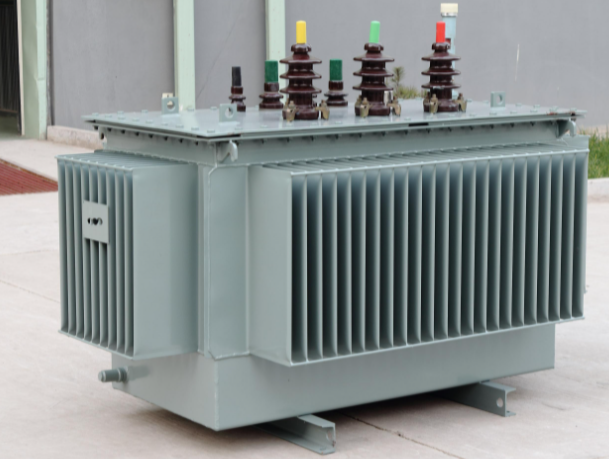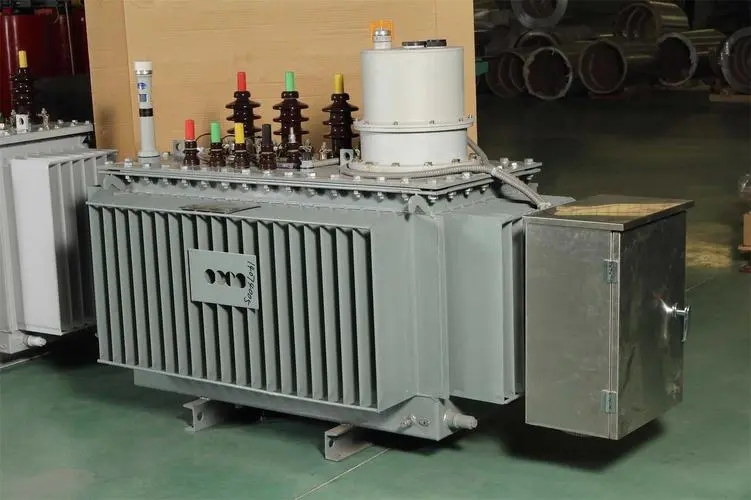


The deformation of transformer winding iron core directly or indirectly damages the transformer, which is a hidden danger. Conventional electrical tests cannot diagnose the vibration online monitoring method of transformers and similar structural power equipment. The first application of parallel reactors in foreign countries to reflect the condition of windings and iron cores through online monitoring of transformer body vibration is in recent years. Compared with methods such as FRALVI and online or offline measurement of short-circuit reactance, the vibration method can not only detect faulty windings, but also detect the condition of iron cores. Moreover, this method has no electrical connection with the power system and is safe and reliable. Therefore, it is necessary to study and understand the vibration characteristics of power transformers under no-load conditions and short circuits. Among them, the no-load vibration characteristics are the foundation. In principle, when power transformers operate stably, silicon steel sheet iron cores The winding generates vibration under the action of electromagnetic field and causes body vibration through the transmission of transformer oil. The vibration on the surface of the transformer body is closely related to the compression, displacement, and deformation status of the transformer winding and iron core. Therefore, the condition of the winding and iron core can be monitored by measuring the body vibration online.
The main magnetic flux generated by the excitation current at the same tap position of the transformer in the iron core remains basically unchanged in magnitude during no-load, load, and load changes. Therefore, the vibration of the iron core caused by magnetostriction also remains basically unchanged. To obtain the vibration characteristics of the transformer iron core at different tap positions, it is only necessary to measure the vibration of the transformer body under no-load conditions. The vibration of the transformer body under load conditions also includes the vibration of the winding under the action of load current. Therefore, the vibration signal of the winding can be obtained by measuring the vibration signal of the transformer under load conditions and comparing it with the vibration signal under no-load conditions. Compared with the normal vibration signal, the vibration signal measured when the transformer iron core or winding is displaced, loosened, or deformed will have higher frequency components, and the amplitude at the original frequency will also change. The larger the displacement deformation, the higher the amplitude. The, The larger the high-frequency components and amplitude changes, the more closely the vibration characteristics at each position of the transformer body are related to the nearest vibration source. Based on the degree of change in the vibration signals measured at each position of the transformer body, it is easy to determine which part of the winding or iron core has malfunctioned. That is, using vibration method to monitor power transformers online can achieve fault location. Therefore, when using vibration method to monitor power transformers online, it is necessary to measure the vibration signals of the transformer body under no-load conditions to obtain the vibration status of the iron core and determine whether the iron core has malfunctioned; The vibration signal of the winding must be removed from the vibration signal of the body when the load is applied, in order to determine whether the winding has a fault. Test and Results 2.1 Test Object and Test Wiring Simulation experiments show that the transformer body vibration signal testing system can correctly measure the acceleration signal of the transformer body vibration (converted into a voltage signal proportional to it through a charge amplifier). Therefore, using this testing system, a vibration test was conducted on the low and high voltage sides of a power transformer in a long-term no-load test. When the transformer cooling system was turned off, the parameters of the transformer were as follows: Model: OSFPSZI2.2 Test Results and Analysis. The vibration sensor was attached with double-sided tape below the outlet neck of the high and low voltage arms respectively. Due to the presence of a test power supply on the low voltage side of phase C, the vibration test wiring phase of the transformer body was not tested. The frequency spectra of the vibration signals of each phase on the high and low voltage sides are shown in Figure 3. After analysis, it is believed that the fundamental frequency of the transformer body vibration during the no-load test is 100Hz, and there are other high-order harmonic components. The harmonics after 1000Hz are basically attenuated to 0, which is consistent with the theoretical analysis results.
The vibration characteristics of the high and low voltage side bodies are different. The amplitude of the vibration signal at the same position on the three-phase high-voltage side in the frequency domain appears at the same frequency position, that is, at 400Hz on the high-voltage side; The amplitude of the vibration signal on the low voltage side in the frequency domain is both at 100Hz, and the fundamental frequency and amplitude of each harmonic of the vibration signal at the same position on the high and low voltage sides are on the same order of magnitude, that is, the frequency domain characteristics are basically the same. However, from the slight differences in the amplitude frequency characteristics of each phase on the high-voltage side, it can be seen that if the amplitude of the main frequency is relatively large, harmonic testing of the no-load vibration characteristics of another 300MVA power transformer found that except for the main frequency appearing at 300Hz on the high-voltage side, other vibration characteristics are the same as those of the transformer mentioned above. Conclusion: The vibration signal of the transformer body has a fundamental frequency of 100Hz and other harmonic components. After reaching 1000Hz, the harmonic amplitude basically decays to 0. For the same position on the high or low voltage side, the vibration signal of the transformer body has a common law, that is, the main frequency of the vibration is the same, and the amplitude frequency characteristics of each phase vibration signal are basically similar. However, the main frequency of different models of transformers may be different due to factors such as transformer structure, iron core and winding compression status of each phase, and transformer box structure. The vibration amplitude of each phase on the same side of the transformer at the same frequency may vary to some extent, but when the main frequency amplitude is relatively large, the amplitude of its harmonic components is slightly higher, and vice versa.
Contact Us
Get to know our new product releases and latest news articles in real-time.
CHANGZHOU CIENWO ELECTRONIC.,LTD.transformed from APEM (WUJIN) ELECTRONIC CO.,LTD, a chinese company of French APEM Group,is a professional manufacturer of molds,stamping products,plastic molded components and rubber products.
Do you have any questions or requests?
Click below, we are happy to provide assistance. Contact Us